The Hidden Cost of an Unfinished Garage

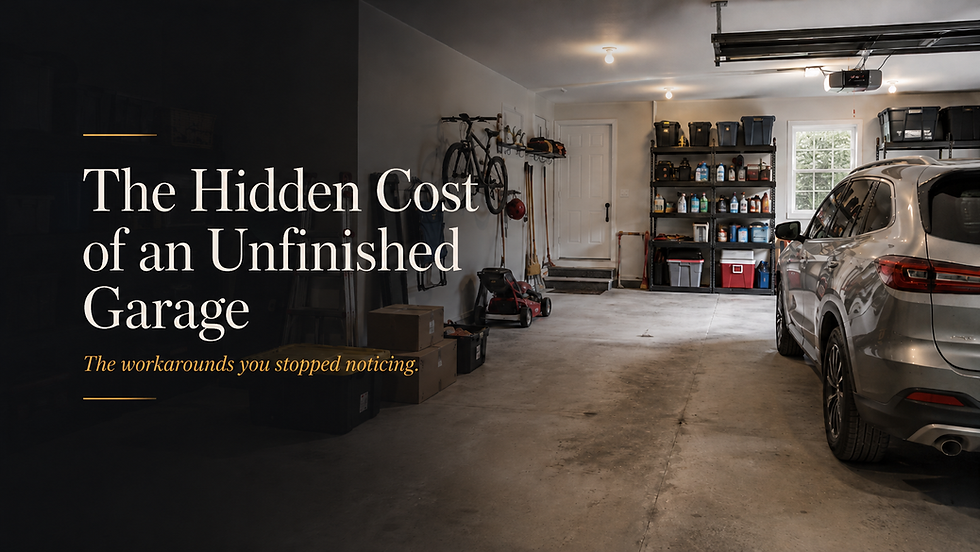
Why an Unfinished Garage Costs More Than Most Homeowners Realize
An unfinished garage is rarely one big, obvious problem.
More often, it is a collection of small inconveniences.
You move something to reach something else. You squeeze between the car and whatever accumulated along the wall. The bikes never really have a place. Seasonal storage keeps expanding. Something that belongs in the garage ends up in the basement, mudroom, or another part of the house.
None of these things feels particularly significant on its own.
But repeat them every day for years, and something interesting happens:
You stop noticing them.
The garage hasn't become more functional. You've simply become better at compensating for it.
And that may be the real hidden cost of leaving a garage unfinished.
We Get Surprisingly Good at Working Around Bad Systems
Think about your own garage for a moment.
Is there something you automatically step around?
Something you have to move before you can get to something else?
A section of shelving you can barely access?
A pile that has been there so long it essentially became part of the room?
Maybe you've stopped parking a vehicle inside altogether.
These little workarounds become routines.
You know which box needs moved. You know where to walk. You know which corner is overcrowded. You know not to put anything else in front of a certain shelf.
Eventually, you don't even think about it.
But familiarity doesn't eliminate friction.
It just makes friction feel normal.
And an unfinished garage can contain an incredible amount of this accumulated friction without ever becoming enough of a problem to force us to address it.
The Unfinished Garage Affects More Than the Garage
The garage doesn't operate independently from the rest of the home.
When it can't effectively handle storage, that storage has to go somewhere.
The basement absorbs some of it.
Closets absorb some.
A mudroom gets crowded.
Seasonal items migrate into spaces that were never intended to hold them.
Dirt and debris travel farther into the house.
The garage may technically still be functioning, but other areas of the home begin compensating for what it isn't doing particularly well.
That's an important distinction.
A poorly functioning garage doesn't simply waste garage space.
It can put pressure on the rest of the house.
You Already Paid for the Space
There's another way to look at this.
The garage isn't free bonus space sitting outside your home.
You already paid for it.
A typical two-car garage represents hundreds of square feet of structure already attached to the home. It has a foundation, walls, a roof, electricity, doors, and direct access to the rest of the house.
You maintain it.
You heat or cool the space around it.
Ohio winters affect it.
Moisture affects it.
Your family moves through it constantly.
Vehicles, tools, sports equipment, lawn equipment, seasonal decorations, household supplies and countless other things depend on it.
The garage is already carrying a significant amount of responsibility.
The question is whether you're receiving everything that square footage is capable of giving back.
The Hidden Cost of an Unfinished Garage Is Daily Friction
When homeowners think about the "cost" of improving a garage, the conversation naturally turns to money.
What does a floor cost?
What do cabinets cost?
What does storage cost?
Those are legitimate questions.
But there's another side of the equation that's harder to put on an invoice:
What does it cost to keep living around a space that doesn't work particularly well?
Not necessarily in dollars.
In time.
In inconvenience.
In clutter.
In lost usable space.
In constantly moving things.
In the irritation of looking for something you know you own.
In having 400 or 500 square feet of space but feeling like you don't have enough room.
That's the accumulated cost.
No single inconvenience is particularly dramatic.
It's the repetition that matters.
An Unfinished Garage Can Create Visual and Mental Noise
There's also something less tangible happening.
Unfinished environments have a way of staying on our mental list even when we're not consciously thinking about them.
The pile that needs organized.
The shelving that never quite worked.
The stained concrete.
The boxes that need somewhere to go.
The project that has been sitting against the wall for six months.
You walk past these things enough times and eventually stop consciously registering them.
But the environment still feels unresolved.
That's one reason a well-planned garage can feel dramatically different even when nothing extravagant has been added.
There is simply less noise.
Things have places.
Movement makes sense.
Surfaces are easier to maintain.
The environment feels controlled rather than temporary.
It's not perfection.
It's resolution.
A Finished Garage Changes the Relationship
This is where the idea of the finished garage becomes important.
Finishing a garage isn't about eliminating its practical purpose.
It's almost the opposite.
It's about allowing the garage to perform its practical responsibilities better.
A finished floor establishes a durable, cleanable foundation.
Storage creates defined places for the things the household actually needs.
Cabinets can remove visual clutter while keeping important items accessible.
Better lighting changes how the space functions.
Wall and overhead storage can reclaim floor space.
And once those foundational pieces are working together, the garage becomes more flexible.
Maybe there's room for a workbench.
Maybe there's space for fitness equipment.
Maybe the kids' bikes finally have a home.
Maybe both cars actually fit again.
Or maybe nothing dramatic changes at all.
Maybe the garage simply becomes easier to live with.
That's enough.
The Goal Isn't a Perfect Garage
This distinction matters because the idea of a finished garage can easily be misunderstood.
Not every garage needs a golf simulator.
Not every garage needs a television, a bar, a home gym, or an elaborate cabinet system.
Some homeowners want those things, and that's great.
Others simply want to pull into a clean garage at the end of the day, park comfortably, find what they need, and walk into their home without navigating an obstacle course.
Both can be finished garages.
The standard isn't extravagance.
The standard is intentionality.
Does the space support the household instead of requiring the household to constantly compensate for it?
That's a much better test.
What Have You Stopped Noticing?
Perhaps the best way to evaluate an unfinished garage isn't to stand in the middle and ask what you dislike about it.
Instead, pay attention to what you automatically do.
What do you step around?
What do you move?
What can you never find?
What takes up space somewhere else because there's no sensible place for it in the garage?
What part of your routine have you quietly adapted because that's simply "how the garage is"?
Those small behaviors tell you something.
Because leaving the garage unfinished isn't necessarily a neutral decision.
Over time, you're making a series of small trades:
Efficiency for workarounds.
Clarity for clutter.
Flexibility for limitation.
Support for compensation.
And when those trades happen long enough, they stop feeling like trades at all.
They simply become normal.
Until you decide they don't have to be.
So here's the question:
What's one thing in your garage you've gotten so used to working around that you barely notice it anymore?
You may also like...


Comments